Blog 1
Scaling telco automation to millions of devices with Managed Red Hat Ansible Automation Platform (AAP) on AWS and Red Hat OpenShift Service on AWS (ROSA)
Managing a nationwide telecommunications network requires handling millions of customer endpoints. Relying on manual management or legacy scripting cannot keep up with the demand for regular updates, monitoring, and troubleshooting.
In this blog post, we shall explore how Managed Red Hat Ansible Automation Platform (AAP) on AWS, while running the execution nodes on Red Hat OpenShift Service on AWS (ROSA), provides an elastic, highly scalable automation solution for managing up to millions of home router broadband gateways, modem-router combos, broadband gateways, and wireless routers.
The Challenge: Visualizing the Customer Service Architecture
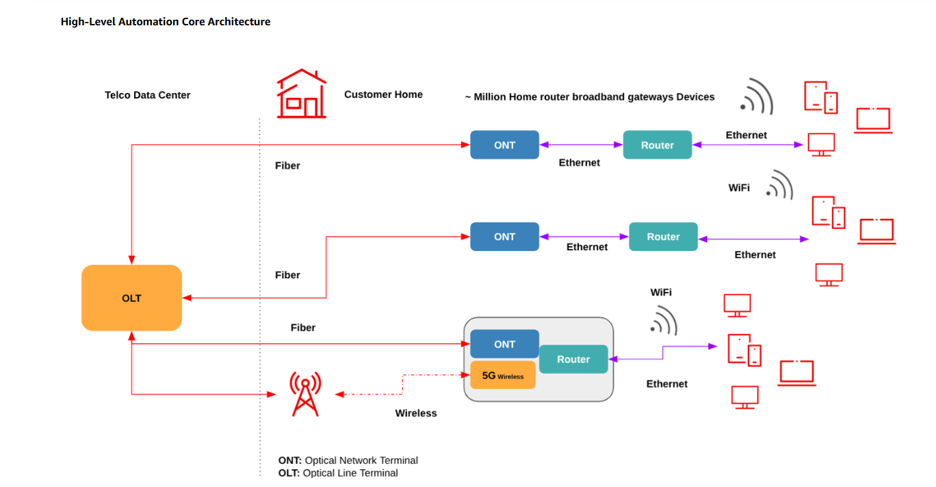
To grasp the scope of the challenge, we must first examine the network edge. The customer service infrastructure originates at the Service Provider Data Center. Here, the Optical Line Terminal (OLT) aggregates the fiber connections from millions of individual “home router broadband gateways.” These gateways are a combination of Optical Network Terminal (ONT) and external home routers and/or an all-in-one hub device (which serves as both an ONT and a router, often with integrated wireless backup). This vast network of connections ultimately reaches end-user devices via WiFi and Ethernet. Managing the lifecycle, data collection, monitoring, and troubleshooting for millions of deployed home router broadband gateways is a constant and demanding requirement.
High-Level Automation Core Architecture
The Core Technologies
This architecture is built on two foundational components:
- Ansible Automation Platform (AAP) Service on AWS: Available as a managed service via the AWS Marketplace, AAP serves as the central automation engine, and has a distributed architecture strictly separating the control plane from the execution plane. This separation allows for independent scaling of automation capacity, improved security, and faster, more reliable execution across geographically distributed environments. Deploying the AAP managed service natively through the AWS marketplace offers unified billing, allowing organizations to bill directly through their AWS accounts and utilize existing cloud committed spend.
- Red Hat OpenShift Service on AWS (ROSA): ROSA is a fully managed, turnkey application platform that provides the recommended, expedited route to a production-ready environment. Jointly engineered and supported by Red Hat and AWS, ROSA manages the underlying OpenShift/Kubernetes “plumbing” so your teams can focus on writing Ansible playbooks and innovating, rather than patching infrastructure.
To manage this vast fleet of home router broadband gateways, the architecture relies on Ansible Automation Platform Service on AWS to provide the Automation Orchestration and Red Hat OpenShift Service on AWS (ROSA) to provide the scalable and cost efficient infrastructure to host the Ansible execution on-demand.
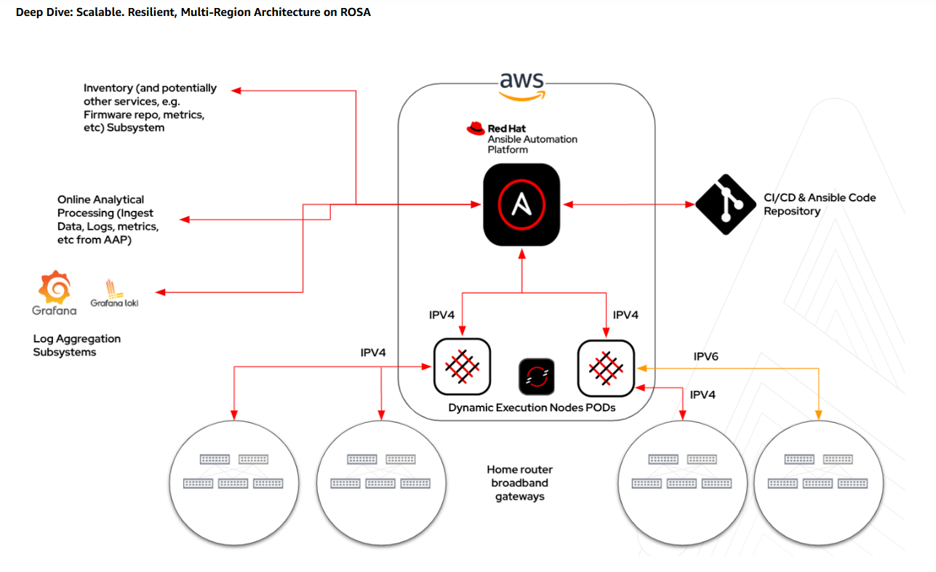
At a high level, AAP dynamically integrates with third-party systems, pulling inventory data from external sources (cloud providers, CMDB, etc.), and syncing its automation playbooks via a Version Control Code Repository, such as GitHub.
When Ansible jobs are triggered, AAP sends the Ansible workload to Execution Node Container Groups in OpenShift clusters. These PODs run the Ansible Playbooks, interacting with home router broadband gateways via IPv4 and/or IPv6 to perform configuration changes, data collection, and management tasks.
To ensure total visibility and full analytics (e.g., train your operations LLM Mode), all execution data, logs, and metrics generated by AAP are continuously ingested into a distributed OLAP (Online Analytical Processing) database designed for real-time analytics and log aggregation systems such as Grafana / Grafana Loki.
Deep Dive: Scalable, Resilient, Multi-Region Architecture on ROSA
Scaling an automation platform to hit millions of endpoints requires robust, distributed infrastructure. By utilizing Red Hat OpenShift Service on AWS (ROSA), organizations get a fully managed environment that handles complex scale.
In this detailed, multi-region architecture, the ROSA deployment happens at each AWS geographic region (e.g., us-east-1, us-west-1, and us-west-2). Within those regions, the infrastructure is heavily distributed across three Availability Zones (AZ-A, AZ-B, and AZ-C) designed to provide high availability for AAP Execution OpenShift pods.
The key to this architecture’s efficiency is the separation of automation control and execution:
- The Control Plane: Ansible Automation Platform Service on AWS will provide the Red Hat AAP Controllers (handling the UI and API requests) that sit centrally within the regions to govern the environment.
- The Execution Plane: On Red Hat OpenShift Service on AWS (ROSA), OpenShift Worker pools dedicated to the AAP Execution Plane are distributed across the availability zones, scaling out horizontally to execute Ansible content and directly connect with the home router broadband gateways.
- Externalized AWS Services: To maintain stateless and lightweight AAP clusters, the architecture offloads data management to native AWS services. You can use Amazon Simple Storage Service (S3) Buckets for scalable object storage to store and manage automation content such as Ansible Content Collection and Automation Execution Environments container images.
Deep Dive: Scalable, Resilient, Multi-Region Architecture on ROSA
The Magic: Scaling Execution Environments During Peak Bursts
The true value of running AAP on ROSA becomes apparent during massive “automation bursts,” such as scheduling a firmware upgrade for thousands of home router broadband gateways. AAP utilizes a split architecture, meaning Automation Controller pods handle incoming API/UI requests, while Execution Node pods (known on Kubernetes as “container groups”) handle the heavy lifting of running the actual Ansible playbooks.
When a massive scheduled job hits, the Horizontal Pod Autoscaler (HPA) instantly detects CPU and memory spikes, and AAP begins spinning up more container pods. But what happens if the underlying physical OpenShift worker nodes (Amazon EC2 instances) run out of capacity?
This is where native scaling mechanisms in ROSA step in to save the day:
- 09:00 AM: The cluster is operating normally under a quiet load, running just 3 worker nodes.
- 09:01 AM: A scheduled “Firmware Tuesday” job initiates for 1,000 home router broadband gateways.
- 09:02 AM: To handle the concurrency (based on configured “fork” settings), AAP requests 200 execution pods.
- 09:05 AM: Because the existing worker nodes are full, the new pods enter a “Pending” state. The ROSA Cluster Autoscaler detects these pending pods and automatically provides the necessary additional EC2 / OpenShift worker nodes in the background. The pods are instantly scheduled as soon as the nodes are ready.
- 09:30 AM: The firmware upgrades complete, and the 200 container pods are destroyed.
- 09:45 AM: The ROSA metrics server observes that the newly created OpenShift worker nodes are now empty. It automatically terminates them, reducing costs on your AWS bill.
The scaling is only limited by two “fences” you set:
- Kubernetes Resource Quotas: You can set a Hard Limit on the namespace where AAP runs (e.g., “This team or AAP cannot use more than 200 CPUs total”). If you hit this, AAP will wait for pods to finish before starting new ones.
- AWS Service Quotas: Even if ROSA wants to scale, it is bound by your AWS account limits (e.g., maximum number of m5.xlarge instances allowed in a region).
The Secret Weapon: Push Logs to OLAP System for AI/Operations LLM Training
Running jobs on millions of devices generates a massive volume of logs. This architecture does not save logs in the traditional way, which can easily cause I/O bottlenecks. Instead, all execution data, logs, and metrics generated by AAP are continuously ingested into a distributed OLAP (Online Analytical Processing) database designed for real-time analytics and log aggregation systems, such as Grafana / Grafana Loki.
Besides providing engineers with a clear dashboard for debugging, the most valuable point here is that this clean and massive log dataset is used as input to train specialized operations AI/LLM models (Operations LLM Mode). In the future, the AI will learn from these logs to automatically detect issues and suggest self-healing actions for the telecommunication network.
Key Advantages Over Traditional Approaches
Besides flexible scaling, this architecture completely solves dependency conflicts across different hardware generations. Each automation scenario is packaged cleanly into its own Container Image (Execution Environment), which is destroyed after execution, leaving no residue and not impacting other processes.
Furthermore, since both AAP and ROSA are fully managed services coordinated by Red Hat and AWS, the operational burden of OS patching, network layer configurations, and infrastructure maintenance is offloaded from the operations team. Engineers can focus entirely on writing playbooks to configure devices.
To protect the business budget, you can set the following control barriers (Fences):
- Kubernetes Resource Quotas: Set a hard limit on the namespace where AAP runs (e.g., maximum CPU usage).
- AWS Service Quotas: Set account-level limits on the maximum number of specific EC2 instances allowed to launch in a region, avoiding infinite loop billing surprises.
Source: AWS Architecture Blog
Post on AWS Study group: AWS Architecture Blog